


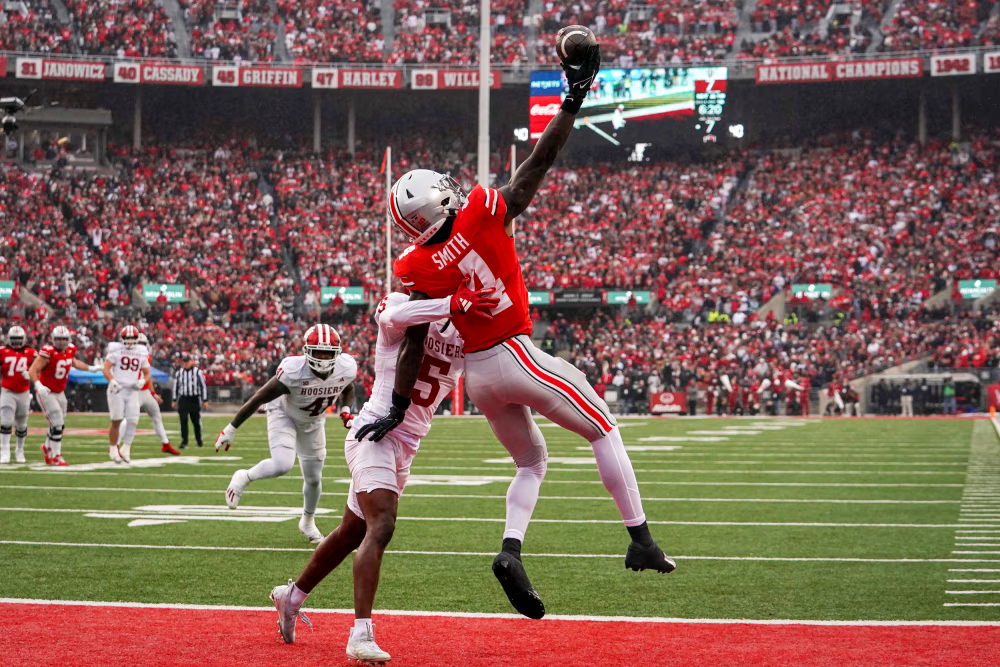
For years, a trip to Bloomington carried a familiar expectation for Ohio State: handle the road environment, bring the talent advantage to life, and get back to Columbus with another conference victory. That expectation no longer tells the story. Indiana has earned the right to be discussed as a championship opponent, and Saturday gives the Buckeyes an opportunity to prove that their own championship ambitions are supported by more than an explosive passing game and a place near the top of the rankings.
No. 4 Ohio State visits No. 5 Indiana in a matchup that should reveal considerably more than either team’s previous comfortable victories. The Buckeyes have responded to their loss at Texas with four consecutive wins, most recently a 45–16 victory over Maryland. Indiana remains unbeaten after escaping Nebraska, 20–17. Both arrive 3–0 in Big Ten play, and neither can afford to assume the other will eventually cooperate.
For Ohio State fans, this is the kind of afternoon that puts all those September conversations into sharper focus. The run game needs to be useful when the defense expects it. Protection needs to hold up when the stadium is loud and the situation is obvious. And if the Buckeyes get themselves into position to win, the final quarter needs to look like a team taking control of its opportunity rather than waiting for the clock to rescue it.
Game Information
| Detail | Information |
|---|---|
| Matchup | No. 4 Ohio State at No. 5 Indiana — AP rankings |
| Coaches Poll | Ohio State No. 5; Indiana No. 4 |
| Records | Ohio State 5–1, 3–0 Big Ten; Indiana 6–0, 3–0 Big Ten |
| Date | Saturday, October 17, 2026 |
| Kickoff | Noon ET |
| Location | Merchants Bank Field at Memorial Stadium, Bloomington, Indiana |
| Television | FOX |
| Broadcast crew | Gus Johnson, Joel Klatt and Jenny Taft |
| Pregame | FOX’s Big Noon Kickoff on site |
| Betting snapshot | Ohio State -3.5; listed totals range from 50.5 to 51.5 |
Ohio State Preview
Ohio State’s victory over Maryland supplied encouraging production without eliminating every concern. The Buckeyes finished with 449 yards, including 207 on the ground, but converted only five of 13 third downs and committed eight penalties for 65 yards. They also converted all three fourth-down attempts. The scoreboard was comfortable; the possession-by-possession efficiency still leaves room for improvement.
That distinction matters against Indiana. A fourth-down conversion can be a sign of confidence and execution, but an offense does not want its weekly identity to depend on repeatedly repairing third-down failures. Ohio State needs more possessions in which a productive first down leads to a manageable second down, and a manageable second down allows Arthur Smith to call from a broad menu. The alternative is allowing Indiana to recognize the passing situation before the Buckeyes have even reached the line.
Julian Sayin has shown he can make the throws this offense needs. His official player log includes 367 passing yards against Illinois, 324 at Iowa and 242 with four touchdown passes against Maryland. The more interesting question Saturday is how consistently he can make the appropriate decision when the first answer is unavailable. A quick completion underneath can be a winning play if it prevents pressure from wrecking a possession; a desperate attempt to preserve a downfield opportunity can undo everything that came before it.
The availability picture provides both help and complications. Wednesday’s report lists Austin Siereveld and Ja’Kobi Jackson as out, along with rotational safety Leroy Roker III. Brandon Inniss, Devin McCuin, Christian Alliegro, Jay Timmons and Phillip Daniels are no longer listed after missing the Maryland game, indicating an expected return. Isaiah West and Anthony “Turbo” Rogers remain among the questionable players. These are the latest published designations, not a guarantee of Saturday’s workload.
Getting receiving options back should help Ohio State avoid funneling every important throw toward Jeremiah Smith. The objective is not to reduce Smith’s influence. It is to make Indiana pay when coverage tilts his direction. An intermediate completion to another receiver, a timely checkdown, or a well-executed run can be the play that eventually makes a larger opportunity possible.
Up front, returning to the lineup and immediately playing a full, clean game are different challenges. I want to see how comfortably the line communicates across combinations, how quickly pressure is identified, and whether help arrives where it is needed. That is especially important when the crowd makes a late adjustment difficult. Ohio State does not need to win every individual block emphatically; it needs enough connected execution that one lost matchup does not become an untouched defender in Sayin’s path.
There was plenty to like about the defensive work against Maryland. Ohio State allowed only 146 total yards, and Jaylen McClain led the team with eight tackles while Eddrick Houston contributed 1.5 tackles for loss. That is useful evidence of individual production, although the challenge now changes from overwhelming an opponent to controlling an offense capable of turning one small mistake into a touchdown.
Matt Patricia’s defense should prioritize making Indiana earn its field position. There is a difference between allowing a completion and allowing a receiver to catch the ball with a clear runway. The pursuit angle, the leverage of the nearest defender, and whether help is arriving from the correct side will matter as much as the initial coverage. A short throw should not become an invitation to race the secondary.
Pressure also needs a purpose. Ohio State should try to disrupt Josh Hoover’s timing without assuming that every important down requires additional rushers. If the front can create discomfort while the coverage keeps its structure, the Buckeyes can force difficult decisions without exposing as much space. When extra pressure does come, the coverage behind it needs to account for Indiana’s quickest answers.
The real test may arrive after a frustrating possession. A missed opportunity on offense, a close officiating decision, or a sudden Indiana score cannot carry into the next defensive series. Ohio State needs its most dependable football when the game becomes emotionally uncomfortable, not only when the script is favorable.
Indiana Preview
Indiana’s offense starts with a quarterback who has protected the ball exceptionally well. Hoover enters with 1,364 passing yards, 17 touchdown passes and no interceptions, completing 88 of 129 attempts. That combination forces Ohio State to think beyond simply waiting for a reckless throw. The Buckeyes need to make the available choices harder rather than assuming the opponent will eventually donate a possession.
The receiving threats are balanced enough to complicate the coverage plan. Indiana’s October 13 notebook lists Charlie Becker with 30 catches for 529 yards and eight touchdowns, and Nick Marsh with 29 catches for 528 yards and six scores. Ohio State cannot treat one as the featured attraction and the other as a secondary concern. Their production is nearly identical in yardage, and either can punish a defense that overcommits elsewhere.
Still, the Nebraska game showed that Indiana can be made uncomfortable. The Hoosiers managed 65 rushing yards, converted one of 10 third downs and held the ball for only 20:27. Nebraska ran 83 plays to Indiana’s 44. Those are opportunities for Ohio State to study, not proof that a repeat will happen automatically. Winning early downs and getting off the field are achievable goals; assuming Indiana cannot score without long drives would be a serious mistake.
Indiana’s ideal offensive afternoon would combine enough rushing success to keep Ohio State honest with selective opportunities outside. The Hoosiers do not have to dominate possession if their passing game produces decisive gains, but they should want fewer series that place the entire burden on an obvious passing down. Ohio State’s task is to keep shrinking the choices until Hoover is being asked to complete the difficult throw rather than the convenient one.
Indiana has real disruption coming from its defensive front. Stephen Daley recorded two sacks at Nebraska after also producing two the previous week, while Tobi Osunsanmi has registered a sack in five consecutive games. The pressure concern is not theoretical, and it gives the Hoosiers a route to influence Ohio State’s passing game before the coverage has to survive an extended play.
Defensive coordinator Bryant Haines faces the familiar dilemma that comes with playing Ohio State: how much attention can be assigned to Smith without making the rest of the field too inviting? The best answer is to create enough disruption up front that the quarterback cannot patiently wait for the coverage to break. That makes Ohio State’s ability to run efficiently and complete quick, well-timed passes particularly important.
Watch the relationship between Indiana’s linebackers and safeties. If the Buckeyes can make those defenders respect the run without relying on extra blockers every snap, the passing windows become more difficult to defend. If Indiana can control the ground game with favorable numbers still available in coverage, Sayin will have to solve a much less accommodating picture.
The Hoosiers’ initial availability report lists running back Khobie Martin as doubtful and tight end Andrew Barker as questionable. Those designations should remain separate from any assumption about who ultimately dresses or how much they play; additional updates can change the picture before Saturday.
Buckeye Spotlight: Bo Jackson
Jeremiah Smith may supply the play everyone remembers, but Bo Jackson could determine how comfortably Ohio State gets there. With Ja’Kobi unavailable, Bo’s role becomes especially important in a game where a dependable rushing answer could prevent the offense from living in difficult passing situations. He is coming off a 107-yard rushing performance against Maryland, giving the Buckeyes something tangible to build on rather than another week of discussing what the ground game might become.
My focus is not a particular rushing total. It is the quality of the ordinary carry. Can Jackson turn a reasonable crease into five yards instead of two? Can he finish forward when there is no clear lane? Can the offense trust him on a late possession when protecting the ball and staying ahead of the chains matter more than producing a highlight?
His work without the ball deserves equal attention. If the protection asks him to identify a threat or absorb pressure, that assignment can be every bit as valuable as a successful run. The most complete performance might include a pickup that gives Sayin time to convert third down and a patient carry that makes the next conversion unnecessary.
Spotlight projection: Jackson produces roughly 90 rushing yards and a touchdown, with his most important contribution coming on a sustained second-half possession. That is our forecast, not a statistical expectation supplied by the team.
Opponent Spotlight: Nick Marsh
Marsh is the clearest reminder that Ohio State cannot equate control of the game with control of every possession. At Nebraska, he caught six passes for 187 yards and two touchdowns, with scoring receptions of 75 and 44 yards in the fourth quarter. Those two plays turned Indiana’s difficult afternoon into a victory.
The first of those scores came on a crossing route, according to Nebraska’s official recap. That matters because an explosive gain does not have to begin with a deep pass. Ohio State’s defenders need to communicate through traffic, take appropriate angles and make the first contact count. Spending the afternoon protecting against the ball over their heads will not help if the decisive gain happens in front of them.
The Buckeyes should make Marsh work for his opportunities without allowing that priority to distort the entire coverage. Respect him, tackle him and move to the next snap. Turning every matchup into a personal attempt to produce a turnover is how a sound defensive plan can become unnecessarily fragile.
Three Keys to the Game
1. Keep Third Down Manageable
Ohio State needs to make its early-down work count. My benchmark is a third-down conversion rate of at least 45 percent, supported by enough short-yardage opportunities that the offense is not repeatedly asking Sayin to rescue the series. That is a Buckeye50 target, not an official team standard. A second-and-six completion that moves the chains can be as valuable as a spectacular third-and-long conversion because it avoids the risk entirely.
2. Prevent the Sudden Change
The Buckeyes need disciplined tackling, secure ball handling and clean special teams. Those are separate units with the same responsibility: do not give Indiana a cheap route back into the game. One explosive touchdown does not automatically decide the outcome, but it can erase several possessions of careful work. Ohio State should make the Hoosiers assemble their scoring chances through repeated execution.
3. Play the Final Quarter to Win
If Ohio State has a lead, the offense still needs a plan for gaining first downs. If the game is tied, the defense cannot become impatient. If the Buckeyes trail, the response needs to be organized rather than frantic. Finishing is not a slogan; it is a collection of decisions, assignments and individual plays made when the margin for error is smallest.
What I’ll Be Watching
The first pressure look Ohio State does not expect. The initial adjustment should tell us something about communication. Does the offense recognize the issue, get to an answer and move forward, or does a single disruption linger across multiple series?
The receiving distribution on important downs. I want Smith involved, but I also want evidence that Indiana cannot identify the target simply by looking at the situation. A reliable complementary option makes the entire offense more difficult to squeeze.
Whether the ground game travels. Productive carries in Columbus are encouraging. Productive carries against this opponent, in this setting, would be more persuasive evidence that the offense is becoming complete.
Tackling after short completions. The difference between forcing a punt and allowing a touchdown may begin with a pass that travels only a few yards. That is a shared responsibility between coverage and pursuit.
The possession after adversity. The strongest indication of maturity may be the next drive after a turnover or the next defensive series after a score. Ohio State needs to show it can reset immediately.
Water Cooler: This Is Not the Old Bloomington Trip
The History That Actually Matters Saturday
Indiana beat Ohio State 13–10 in last season’s Big Ten Championship Game. Saturday is also the first top-five matchup in Memorial Stadium history. Those facts capture the change in this series more effectively than reaching back through decades of Ohio State dominance: the Hoosiers have already shown they can win the game the Buckeyes wanted most, and now they get the rematch at home.
That should sharpen Ohio State’s approach without turning the afternoon into an emotional referendum on last December. Revenge is a useful headline. Protection, tackling and finishing drives are useful football. The Buckeyes need the latter to make the former possible.
The Streak Behind the Confidence
Indiana enters with 22 consecutive victories and has at least tied the turnover battle in 30 straight games, according to its official game-week release. That second number is especially revealing. Ohio State should prepare for an opponent that does not routinely hand away possessions and is comfortable letting the game remain competitive.
The response should not be to force a takeaway because the streak looks intimidating. It should be to value the ball on offense, finish tackles on defense and accept that beating a disciplined opponent may require several ordinary plays in a row. Patience and aggression are not opposites when the aggression is attached to a sound decision.
Jeremiah Smith’s Next Chapter
Smith enters with 48 receptions, 916 receiving yards and 11 touchdown catches this season. Ohio State’s official preview places his career totals at 211 catches, 3,474 yards and 38 receiving touchdowns. He needs two more touchdown catches to move past the Big Ten career record, while another 100-yard receiving performance would give him a program-record 16 career games at that mark.
The record chase belongs in the conversation, but not in the play-calling priorities. If Indiana devotes extra coverage to preventing Smith’s next milestone, Ohio State should welcome the opportunities that creates elsewhere. His most meaningful contribution could be the attention that opens the winning drive, even if somebody else catches the final pass.
What It Means for the Bigger Picture
A victory would give Ohio State another ranked road win and keep its conference record clean heading into the open week. A loss would not, by itself, settle the postseason picture, but it would leave the Buckeyes with a second defeat and considerably less room to navigate the remaining schedule. Neither outcome should be reduced to an automatic playoff verdict in mid-October.
For Indiana, the opportunity is to reinforce that last season’s success has carried into another team and another quarterback. For Ohio State, it is a chance to demonstrate that the lessons from Texas can be applied under comparable pressure. The most convincing argument either team can make will be on the field.
Buckeye50 Prediction
I expect Indiana to make this uncomfortable well into the second half. The Hoosiers have dangerous receiving options and enough disruption up front to prevent Ohio State from treating the afternoon like a passing exhibition. The Buckeyes will need to accept some modest gains, protect possessions and resist the temptation to solve every difficult series with a low-percentage shot.
My pick comes down to Ohio State finding enough rushing efficiency to create a few favorable passing situations, then turning those opportunities into touchdowns rather than settling repeatedly for field goals. I expect Smith to make at least one major play, but the deciding possession could belong to Jackson and a complementary receiver rather than a single spectacular catch.
This is a game to win with connected football: a stop that creates useful field position, an offense that converts it into points, and a final series that does not give the opponent another opening. I am picking the Buckeyes to produce that sequence late and leave Bloomington with their most meaningful victory of the season.
Final Score: Ohio State 30, Indiana 24.
What is your prediction, and which matters most Saturday: protection, the running game or limiting Indiana’s explosive plays?
Photo Credit: Jason Mowry / Getty Images